 Language
 English
 Português
 Deutsch
 Français
 русский
 Italiano
 日本語
 عربي
 Español

In food processing, the size and purity of a powder often decide whether a product meets its texture, solubility and labeling targets. As lines handle finer and more cohesive ingredients, conventional screening can struggle with blinding and low throughput. An ultrasonic vibrating screen addresses these issues by adding high-frequency, low-amplitude energy to the mesh, and it has become a practical option for a range of food applications.
What Is an Ultrasonic Vibrating Screen
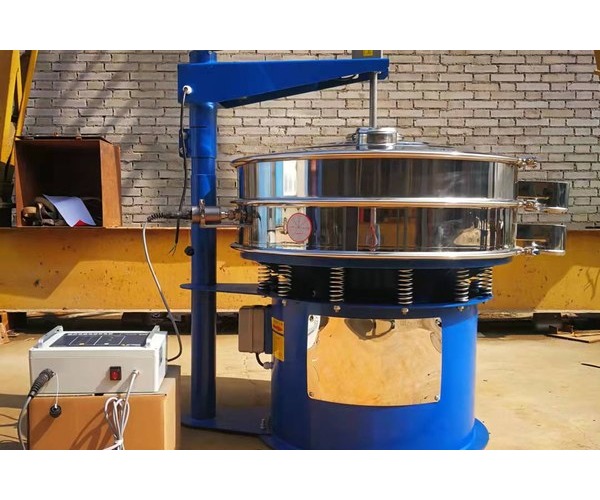
An ultrasonic vibrating screen is a standard circular vibrating sieve fitted with an ultrasonic transducer and generator. The generator converts electrical power into high-frequency oscillations, which are transmitted through a special screen frame to the mesh. These micro-vibrations keep particles moving at the aperture and reduce the tendency of fine or sticky material to clog the screen. The result is a cleaner cut and more stable throughput without raising the mechanical amplitude of the machine.
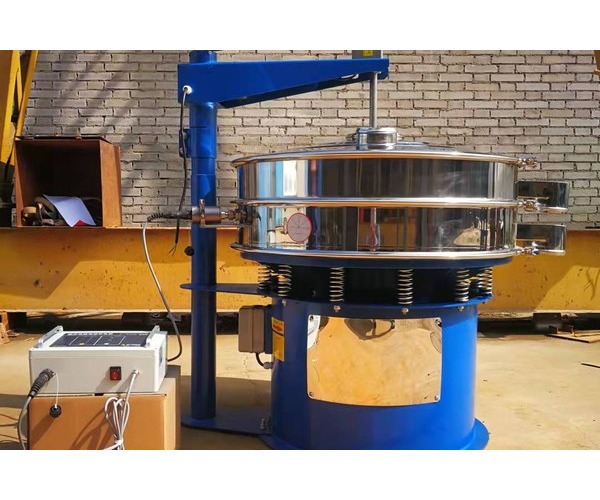
Figure: An ultrasonic vibrating screen prepared for fine food powder classification.
Why Food Powders Are Difficult to Screen
Many food ingredients are fine, dry and electrostatic, or contain moisture and fat that make them cling together. Spices, starches, dairy powders, sugar, flour and protein blends can bridge openings or form a layer on the mesh that blocks further flow. When that happens, operators see lower output, inconsistent particle size and frequent manual cleaning. Gentle ultrasonic assistance helps keep the apertures open so classification stays consistent over a longer run.
Typical Food Industry Applications
An ultrasonic vibrating screen can be used across several stages of food production:
- Spices and seasonings: removing lumps and achieving a uniform grind for consistent flavor and appearance.
- Flour and starches: classifying fine fractions and removing foreign particles before further processing.
- Dairy and protein powders: breaking up soft agglomerates and improving flowability for dosing and packing.
- Sugar, salt and additives: separating oversized crystals to meet specification for table or industrial use.
- Ready-to-mix products: ensuring a homogeneous blend before portioning into sachets or containers.
Practical Benefits for Food Plants
Plants that adopt an ultrasonic vibrating screen often value its ability to handle fine meshes that would otherwise blind quickly. The screening action is gentle, which helps preserve the structure of fragile particles, and the shorter cleaning intervals can support more continuous operation. Contact surfaces are commonly made of stainless steel to align with food hygiene expectations, and the open design allows straightforward inspection and wash-down between batches.
Selection and Hygiene Considerations
When specifying an ultrasonic vibrating screen for food, factors such as mesh aperture, screen diameter, material of construction and the power of the ultrasonic system should be matched to the ingredient and the required throughput. Sanitary design, easy disassembly and safe cleaning routines are important in a food environment. As with any process equipment, trials with the actual product are recommended to confirm that the desired separation and output are achieved.
Final Thoughts
Consistent screening supports consistent food quality. By keeping fine meshes clear and classification stable, an ultrasonic vibrating screen can help processors manage difficult powders with less downtime and more predictable results. Producers are encouraged to evaluate the configuration against their own materials and hygiene requirements before committing to a line.


